
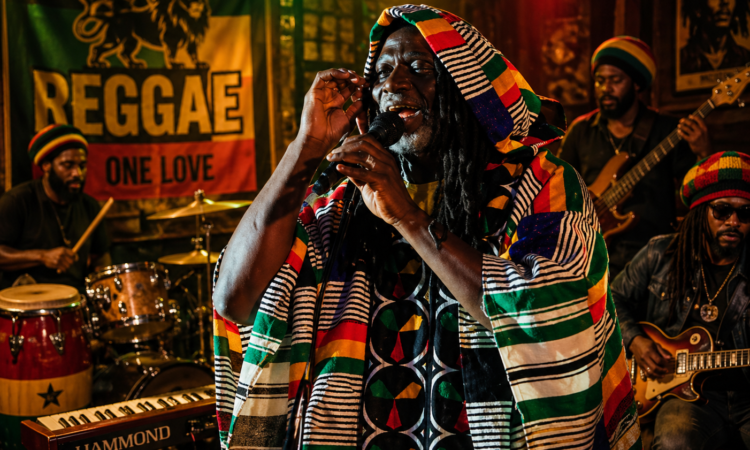
In the summer of 2003, a man packed what he could carry and left his homeland. He did not leave because he had failed — he left because he had succeeded too well. His songs had cut too close to the bone, his words had rattled the powerful, and the death threats that followed made staying impossible. That man was Tiken Jah Fakoly, and his exile to Bamako, Mali, would not silence him. If anything, it amplified everything he stood for.
For more than three decades, Tiken Jah Fakoly has been one of the most fearless and consequential voices in African music. Born in the red-earthed town of Odienné in north-western Côte d’Ivoire, he transformed reggae — a music born in the Caribbean heat of resistance — into a weapon forged entirely for Africa. His lyrics indict corruption, mourn colonialism’s long aftermath, and call millions of Africans by name into a dream of unity and self-determination. He does not sing for applause. He sings, as he has always said, “to wake up the consciences.”
Roots in Odienné: A Boy Who Could Not Ignore Injustice
Doumbia Moussa Fakoly came into the world on June 23, 1968, in Odienné, a market town nestled in the Kabadougou region near Côte d’Ivoire’s northwestern frontier. His lineage was extraordinary — family oral history traces his ancestry to Fakoly Koumba Fakoly Daaba, a legendary Malinké warrior chief who served under Emperor Soundiata Keïta in the 13th century. Though that heritage may have seemed distant, it ran like a quiet current through the boy who would become Tiken Jah Fakoly.
He grew up in a Muslim family, surrounded by the rhythms of Malinké culture and the moral seriousness of Islamic tradition. From childhood, he had an acute and almost visceral sensitivity to injustice. In an interview, he recalled being eleven years old on a visit to Abidjan, watching with fury as adults exploited and hit younger children. “I would express myself even if it was toward elders,” he later said. “I’m not sure if my revolt started at this time but I was always conscious.” It was not the consciousness of a troublemaker — it was the consciousness of a future griot, a truth-teller in the oldest West African tradition.
Griots — known in Malinké as djelis — are the hereditary keepers of history, the oral poets and social conscience of West Africa’s great empires. Tiken Jah Fakoly came from this world, and it shaped him profoundly. But the instrument he would eventually choose was not the kora or the balafon alone — it was reggae, that insurrectionary music from Jamaica that he discovered as a young man and recognized immediately as a kindred spirit.
The Discovery That Changed Everything
It was through the music of Bob Marley and the legacy of Alpha Blondy — Côte d’Ivoire’s pioneering reggae icon — that young Doumbia Moussa Fakoly first felt that his anger and his love for Africa had a sound. Reggae spoke of Babylon and liberation, of overcoming the chains of imperialism — and in the context of post-colonial Africa, those themes were not metaphors. They were daily life.
In 1987, the year his father died, Fakoly found himself both grieving and, for the first time, truly free. With his father gone, the family resistance to his musical ambitions could no longer hold him back. He assembled his first group, which he called Djelys — deliberately invoking the griot tradition, signalling from the very beginning that this was not entertainment alone, but testimony. The band played local concerts in Odienné and the surrounding towns of the Kabadougou region, building a modest following with their politically charged energy.
The early years were neither glamorous nor easy. Fakoly’s family was slow to support the path he had chosen. His first official recordings came in 1993 with Les Djelys, followed by Missiri in 1994 — albums that circulated regionally and planted the seed of a national reputation. But it was the death of President Félix Houphouët-Boigny in 1993, and the turbulent power vacuum it created in Côte d’Ivoire, that gave Fakoly his first major canvas. He wrote and recorded with a young nation’s restlessness, and Ivorian youth — hungry for a voice that sounded like their frustration — responded.
Mangercratie and the Making of a National Voice
By the mid-1990s, Tiken Jah Fakoly had moved from regional curiosity to national sensation. His 1996 album Mangercratie — a biting, untranslatable portmanteau of “manger” (to eat) and “démocratie” — crystallised everything he had been building toward. The album dissected the corruption and hollow governance that had infected Ivorian political life, and it did so with a sardonic wit and moral clarity that resonated far beyond Abidjan. The youth found in Fakoly’s voice exactly what they had been looking for: someone who named the thing they saw every day but could not yet articulate.
Two years later, in 1998, Fakoly crossed the Atlantic to Paris for his first international performance. The Ivorian diaspora in France embraced him immediately. Here was a man who did not perform Africa for foreign audiences — he brought Africa to foreign cities on his own terms, with his own urgency. The international stage would become as natural to him as the dusty concert grounds of Odienné.
Then came Françafrique. Released in 2002, the album confronted head-on the web of political and economic entanglements between France and its former African colonies — a system that kept African governments dependent and African populations poor. The word “Françafrique” had been coined decades earlier as a critique of neocolonialism, and Fakoly turned it into an anthem. The album earned him the prestigious Victoires de la Musique award in 2003 for Best Reggae/Ragga/World Album, catapulting him into global recognition. He was no longer simply a Côte d’Ivoire phenomenon — he was Africa’s reggae ambassador.
Exile and the Price of Truth
The more powerful Fakoly’s voice became, the more dangerous it grew for him to remain in Côte d’Ivoire. As the country descended into political instability and xenophobia in the early 2000s, his unflinching commentary made him a target. Death threats arrived. The man who had spent his life singing against fear was now being asked to be afraid. He refused — but he was not reckless. In 2003, he relocated to Bamako, Mali, and established what would become a new creative home.
The exile was painful, but it also broadened him. Bamako, a city of vibrant music and political energy, nourished a new chapter in his work. He built Tiken Jah Studio there, creating not only his own albums but a platform for emerging West African artists. From exile, the man who had been driven out of one country became a continental figure — proof that authentic art cannot be contained within borders.
Coup de Gueule, released in 2004, was the sound of that exile — raw, urgent, uncompromising. L’Africain followed in 2007, recorded in an acoustic session with producer Jonathan Quarmby that stripped the music down to its spiritual core. Then came African Revolution in 2010, which pushed the sonic palette further still — weaving in the kora, ngoni, balafon, and djembé, instruments that had been singing West Africa’s stories long before the word “reggae” existed.
One Concert, One School: Music as Action
Tiken Jah Fakoly has never believed that singing about injustice is enough. In 2009, he launched a campaign that would define his legacy as much as any album: Un concert une école — One Concert, One School. The principle was simple and devastating in its clarity: every concert he performed would generate funds to build or support a school. Through this initiative, he financed the construction of a primary school in the village of Touroni and a secondary college in Dianké, both in Mali.
He performed concerts across Burkina Faso, Côte d’Ivoire, and Guinea — each show accompanied by a massive educational outreach campaign. The message was not only musical; it was developmental, insisting that African dignity began with African knowledge. In a continent where access to quality education remains profoundly unequal, Fakoly’s campaign was an act of structural defiance.
His collaborations over the years have been equally far-reaching. He has recorded with Sly & Robbie, Alpha Blondy, Steel Pulse, Amadou & Mariam, and Akon. He contributed to the 2014 track Cocoa Na Chocolate in support of ONE’s Do Agric, It Pays campaign, aligning his voice with the cause of African agricultural self-sufficiency. Each collaboration extended the reach of his message, finding new ears for the same ancient urgency.
A Paradox Carried with Integrity
Part of what makes Tiken Jah Fakoly so compelling — and so human — is the integrity with which he holds his apparent contradictions. He is a practising Muslim who has deeply absorbed the spiritual ethos of Rastafari. He is a griot’s descendant who chose reggae. He is a man of peace who has never shied from speaking truth to power at personal cost. He occasionally smokes marijuana, but consistently discourages others from doing so, never allowing the symbol to overshadow the substance.
He has spoken with equal candour about the social injustices within African communities themselves — the caste discrimination against griots, the clan hierarchies that denied people the freedom to love across social lines — refusing to let anti-colonialism become an excuse for ignoring the injustices closer to home.
Dernier Appel to Le Monde est Chaud: Still Burning
Dernier Appel — Last Call — released in 2014, arrived with the weight of a man who had seen decades of broken promises. The title itself carried a warning: the continent had been waiting for justice long enough. Racines in 2015 looked backward to look forward — a collection of the reggae standards that had formed Fakoly’s musical consciousness as a teenager, performed now with the fullness of a mature artist.
By the time Le Monde est Chaud — The World is Hot — arrived in 2019, Fakoly had entered a new creative phase. Working with the young producer Akatché, he fused the architectural bones of Mandingo reggae with the vitality of new African urban sounds. The kora, ngoni, sokou, kamele ngoni, balafon, and djembé appeared on those tracks not as nostalgic ornament but as living, urgent instrumentation — ancestral voices speaking to contemporary crises. The album featured collaborations with Soprano, Gaël Faye, and R.Wan, reaching across generations and genres while never diluting the message at the centre.
A Legacy Still Being Written
To understand Tiken Jah Fakoly is to understand something essential about the relationship between art and resistance. He did not come to music to escape the world — he came to it to change the world, the way griots have always done, the way the best reggae has always done. He fused those two traditions — the ancient and the modern, the West African and the Jamaican — into something new and irreplaceable: Mandingo reggae, a genre he effectively created through sheer force of vision.
His studio in Bamako continues to be a sanctuary for young West African artists who need both a space and a model. His schools in Mali stand as physical monuments to the belief that music is not separate from community — it is community. His exile, rather than diminishing him, has made him a symbol of a truth that authoritarian power can never quite extinguish: that the voice cannot be deported.
Today, Tiken Jah Fakoly remains one of reggae’s most powerful living voices and one of Africa’s most vital cultural figures. He carries a lineage that reaches back eight centuries — to warriors, griots, and kings — and carries it forward into a future that Africa is still fighting to define. As long as there are injustices to name and consciences to wake, his music will find its moment. The world may be hot, but Tiken Jah Fakoly is still singing — and that, for millions across the African continent and its diaspora, is reason enough to keep believing.