
Picture a child in Abidjan, rising before dawn. She and her cohort strap djembe drums to their backs, set off running into the mountains, and sing — their voices rising through the dark air like something ancient and unstoppable. This was not play. This was training. This was the making of Dobet Gnahoré.
Born on 17 June 1982 in Côte d’Ivoire, Dobet Gnahoré grew up not in an ordinary home but in a world unto itself — the Ki-Yi M’Bock artistic village of Abidjan, a creative community co-founded by her father, Boni Gnahoré, a celebrated Ivorian percussionist, comedian, composer, and choreographer. Under the visionary direction of poet and playwright Werewere Liking, Ki-Yi M’Bock was more than a cultural institution; it was a living philosophy — a belief that African art could nurture, heal, and transform. For the young Dobet, it was simply home.
That home was extraordinary in its demands and its gifts. Artists from across the African continent passed through its gates. Rhythms from Mali, Cameroon, the Congo, South Africa, and East Africa mingled freely in the air she breathed. Dance, theater, music, and ritual were not subjects to be studied but forces to be inhabited. By the time she was a teenager, Dobet had already absorbed what most musicians spend lifetimes searching for: a deep, embodied knowledge of Africa’s vast and varied musical inheritance. She sang in seven languages. She danced with the authority of someone who understood that the body itself is an instrument. She played percussion with the precision handed down through generations of the Bété tradition, the ethnic heritage of her father’s people.
But the world that had shaped her was about to be shaken.
Exile and Emergence
In 1999, the political tensions that had long simmered in Côte d’Ivoire finally erupted into civil conflict. Like thousands of Ivorians, Dobet was forced to leave. She was seventeen years old, a young artist uprooted from the only world she had ever known, and she carried with her nothing but her voice, her rhythms, and the discipline that Ki-Yi M’Bock had branded into her bones.
She made her way to France, eventually settling in Marseille — a port city whose vibrant African and North African diaspora offered its own kind of cultural crossroads. It was there, in the humming, sun-soaked streets of the Marseillaise arrondissements, that Dobet began to refashion herself. She sought out musicians, collaborated restlessly, and found a new kind of teacher in Congolese legend Ray Lema, who took her under his wing and revealed something she hadn’t yet fully mastered: the architecture of a song. Lema taught her composition, structure, the craft of shaping raw emotion into music that could travel — across languages, across borders, across lives very different from her own.
It was also at Ki-Yi M’Bock, before the exile, that Dobet had met French guitarist Colin Laroche de Féline, who had traveled to Abidjan specifically to immerse himself in African music. Their connection was immediate and creative. In 1999, the two made a pact: they named their duo Ano Neko — “Let’s create together” in the Bété language — and set out to build something new from the wreckage of displacement.
They spent the next years touring France, their sound an intimate weaving of Dobet’s powerful vocals and Colin’s sensitive guitar work. The music drew from Manding melodies and Congolese rumba, from Ivorian ziglibiti and Cameroonian bikutsi, from Ghanaian highlife and Zulu choral traditions. It was, in the truest sense, pan-African: not a single country’s music, but a distillation of a continent’s spirit filtered through two people who had been formed by its most creative crossroads.
The Album That Introduced the World
By 2003, their artistic vision had expanded. A backup vocalist and percussionist joined them, and Belgian management agency Contre Jour stepped in to help realize what had been brewing for years. The result was Ano Neko (2004), Dobet’s debut album — part of it recorded in Abidjan, part in Belgium during the summer of 2003 — and it announced her arrival to the world music stage with the confidence of someone who had been preparing for this moment her entire life.
The album was a kaleidoscope. The sanza, balafon, calabash, and bongos provided a foundation of pure African texture beneath Dobet’s warm and powerful voice. She sang in Bété, Fon, Baoulé, Lingala, Malinké, and French. Critics heard echoes of Zap Mama and Sally Nyolo, but Dobet’s sound was unmistakably her own — rooted, joyful, and shot through with a kind of urgent tenderness. She was not merely representing a tradition; she was expanding it.
Audiences across Europe responded with immediate enthusiasm. Tours followed, then a growing reputation on festival circuits, and then a string of subsequent albums that deepened and evolved her artistic signature. Tchin Tchin arrived in 2007, further cementing her status as one of Africa’s most exciting live performers. Djekpa La You in 2011 showcased her capacity to absorb new influences — soukous, Malian blues, East African kalimba — without ever losing the thread back to her roots. On that album, she shared vocal space with South African legend Vusi Mahlasela, and the interplay between his striking, high-pitched timbre and her honeyed warmth produced some of the most memorable moments of her career.
A Grammy and a Historic First
Then came 2010, and a moment that would change everything.
American R&B artist India.Arie was recording a cover of Sade’s Pearls, and she wanted Dobet’s voice beside her own. The collaboration was as transatlantic as it was transformative — the gentle meeting of two women from opposite sides of the ocean, bound by a shared belief in the power of music to carry truth. When the Recording Academy gathered for the 52nd Grammy Awards, Pearls won Best Urban/Alternative Performance.
Dobet Gnahoré had become the first Ivorian artist ever to win a Grammy Award.
The achievement was not merely personal. In a country still healing from years of political fracture, it was a moment of collective pride — a signal to the world that Côte d’Ivoire was home to world-class artistry, and to young Ivorians that the stages of the world were within their reach.
Return, Renewal, and Purpose
The years that followed brought continued evolution. Dobet released Na Drê in 2014 and Miziki in 2018, expanding her sonic palette and deepening the social consciousness that had always underpinned her lyrics. She had long used her music to address pressing human concerns — the importance of family, the AIDS crisis, the resilience of African communities in the face of hardship. Her art was never decorative. It was always, in some fundamental way, purposeful.
During the COVID-19 pandemic, when the world fell quiet, Dobet returned to Abidjan. What might have been a retreat became a creative rebirth. Working with 22-year-old Ivorian producer Tam Sir, she tapped back into the source — the heat of the city, the rhythms of home, the conversations she had longed to have with musicians who shared her roots. The result was Couleur (2022), released through Cumbancha, an album that critics immediately recognized as one of her finest: upbeat, rootsy, modern, and deeply alive with the energy of a woman who had returned to herself.
Then, in 2024, she released Zouzou — a word meaning “Angel” in French. Produced by the acclaimed Momo Wang (Dr. Wang), who had worked with Aya Nakamura and Ariel Sheney, the album blended African rhythms with contemporary influences and carried a message close to Dobet’s heart. It was dedicated to the children of Africa — to those navigating hardship, to those carrying the future in their hands. Alongside the album’s release, Dobet announced plans for a new orphanage in Côte d’Ivoire, turning her creative vision into direct, tangible care for the next generation.
The Artist and the Ancestor
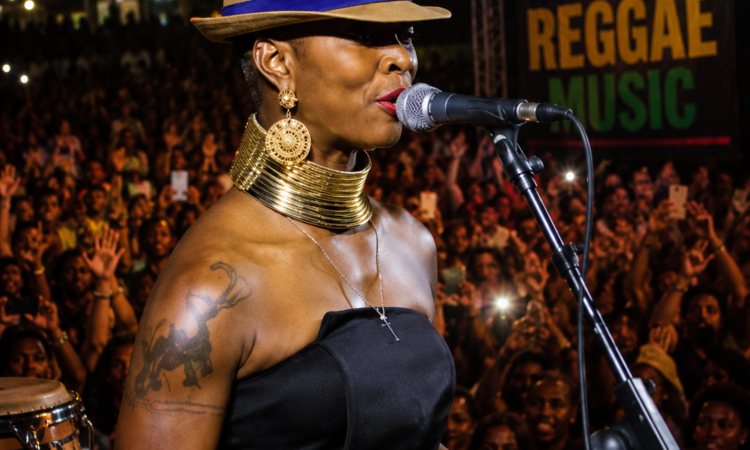
To watch Dobet Gnahoré perform is to understand something essential about what music is for. She is a singer, yes — but also a dancer, a percussionist, a storyteller in the tradition of the West African griot, those ancient messengers of praise and vision whose oral tradition stretches back to the 13th-century Mande Empire. She carries that lineage consciously, seriously, joyfully. Her stage presence is commanding without being distant, spiritual without being remote. She makes the audience feel that they, too, are part of something larger than the night’s entertainment.
Her band, Na Afriki — composed of French, Tunisian, and African musicians — reflects the same cosmopolitan spirit that has defined her entire career. The sanza and balafon stand beside the guitar; reggae rhythms weave through Congolese rumba; East African melody rubs shoulders with West African percussion. It is a sound that refuses borders because Dobet Gnahoré herself refuses them.
In seven languages, across seven studio albums, through civil war and exile, through Grammy stages and village orphanages, she has remained remarkably consistent in what she stands for: the richness of African culture, the necessity of community, the power of art to carry people through darkness toward something luminous.
A Voice for the Future
Today, Dobet Gnahoré continues to move between worlds — between Côte d’Ivoire and France, between tradition and innovation, between the global stage and the intimate work of building something lasting at home. She is, at once, an ambassador for her country and a servant of the wider African continent; a Grammy-winning international star who spends her platform advocating for children without homes.
She was built by a village, and she has never forgotten that. In everything she creates — in every drum struck, every language sung, every orphan sheltered — she is still, in some essential way, that girl running through the mountains before dawn with a djembe on her back, raising her voice into the dark.
The world has been listening ever since.
Dobet Gnahoré is a Grammy Award-winning singer, dancer, and percussionist from Côte d’Ivoire. Her latest album, Zouzou, was released in 2024.