
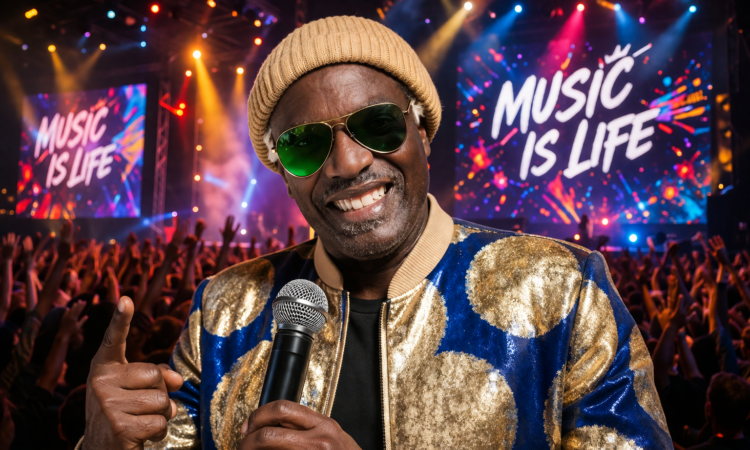
There is a moment in every great artist’s life when the noise inside them becomes too loud to contain — when the world’s indifference stops being a reason to stay silent and becomes, instead, the very fuel of their song. For Seydou Koné, that moment came not in a grand concert hall or a recording studio, but in the grimy streets of Abidjan, where a young man barely returned from New York found himself nearly beaten to death in a police raid he had done nothing to deserve. He would survive. And from that wound, he would write one of the most consequential songs in African music history.
The world would come to know him as Alpha Blondy — “the first bandit.” The name, as it turned out, fit perfectly.
Roots: Born in the Red Dust of Dimbokro
Seydou Koné was born on January 1, 1953, in the Ivory Coast town of Dimbokro, a member of the Dioula ethnic group. His entry into the world on New Year’s Day would prove prophetic — as though the universe itself was making room for something new.
The eldest of nine children, he was raised by a loving grandmother named Cherie Coco, a woman whose warmth and moral clarity would shape his worldview long before music ever did. His upbringing, surrounded by elderly women, greatly influenced his musical work: he learned the most widely spoken language in West Africa, Dioula, and the values instilled in him — such as never lying and prioritizing truth above all.
Alpha Blondy comes from a family of Malinké origin. His father was a descendant of Samory Touré, a great warlord and ruler of the Wassoulou empire. There was blood in him that had never bowed easily to power — and though young Seydou had no way of knowing it yet, that inheritance would define every song he ever wrote.
He was raised in the predominant Islamic faith of his people but also learned French by reading the Bible. From childhood, he inhabited the overlap between worlds — Muslim and Christian, African and French, traditional and modern. That fluency in contradiction would one day become his greatest artistic gift.
Though he grew up listening to African folkloric music such as yagba and gumbe, his primary musical influences were such Western bands as Deep Purple, Pink Floyd, Hendrix, the Beatles, Creedence Clearwater Revival, and soul artists like Otis Redding. Later, one voice above all others would change him completely: Bob Marley. Here was music that crossed every border — spiritual, political, rhythmic — and did so without apology.
The Road Out: Liberia, New York, and a Dream That Wouldn’t Die
His education was interrupted after an incident involving his math teacher, and he sought to make amends to his outraged family by continuing to study English in the neighboring English-speaking country of Liberia. He was nineteen years old, restless, and burning with something he couldn’t yet name.
It took three years to reach New York. During this time, he perfected his English, composed numerous songs, and solidified his identity — dropping earlier pseudonyms and signing his letters simply as “Blondy.” The nickname itself carried a story: his grandmother Cherie Coco had given him the name, her unique pronunciation of the word “bondee” — a Jula-French pun for “bandit.” He wore it like armor.
In late 1973, Alpha Blondy arrived in New York, where his dream began to take shape. He enrolled at the Geneva School of Business, then Hunter College, and finally passed the tests to enter the American Language Program at the prestigious Columbia University. Outside of class, he would play music in Central Park and in Harlem clubs where occasionally house bands would let him sing Bob Marley covers in French, English, and various West African languages.
Those nights in Harlem clubs, singing in three languages to audiences who had never heard anything quite like him, were the true beginning. In New York, Blondy met many figures in the Caribbean and Jamaican movement, which was his first real exposure to Rasta philosophy. The encounter was electric. Here was a spiritual and political framework that seemed tailor-made for everything he already believed — about justice, about Africa, about the power of music to heal what politics could not.
One night, record producer Clive Hunt heard Blondy sing and invited him to record six songs. Unfortunately, Hunt absconded with the tape. It was the first in a long series of betrayals, setbacks, and near-misses that would have broken a lesser spirit. But Seydou Koné was not a lesser spirit. He returned to Ivory Coast carrying nothing but the songs inside him — and that, it would turn out, was enough.
The Fall and the Rising: Abidjan and the Birth of a Star
The homecoming was brutal. According to some accounts, his hardship continued for some time in Abidjan, but Seydou Koné kept writing his own original songs and eventually started using the name Alpha Blondy — “first bandit.” He played the Adjamé ghetto with Ghanaian musicians, living on the margins, refusing to disappear.
Then came the break. Blondy’s old friend Fulgence Kassi, an employee of Ivory Coast Television, helped him land a spot on the Première Chance talent show. Singing three of his own tunes plus Burning Spear’s “Christopher Columbus,” the young artist was a hit with the audience. Something cracked open. Ivorians watching television that evening encountered a voice they had never heard before — African to the bone, yet drenched in reggae, singing in Dioula and French with a rawness that seemed to come from a place beyond performance.
Blondy recorded his debut album in a single day. It was called Jah Glory, and it would become a phenomenon. Jah Glory became an African million-seller in 1982. The most popular song, “Brigadier Sabari,” was an account of Blondy’s run-in with an Abidjan police street raid: it was the first time a West African artist had dared to mention police brutality in public.
The courage of that gesture cannot be overstated. In a continent where speaking truth to power could get you disappeared, a young musician stood in front of a microphone and described what had been done to him — and to so many others — with unflinching clarity. The people heard it and wept and laughed and passed the record hand to hand. Brigadier Sabari was not just a song. It was a reckoning.
Jerusalem, Masada, and the Making of a Global Voice
With Jah Glory‘s success, Alpha Blondy and his newly formed Solar System band signed to EMI and recorded his second album, Cocody Rock, in Paris in 1984. The sound was sharper now, more polished — but no less honest. Three years before the release of his 1987 album Revolution, he had been voted the number one artist by a Radio France international poll. Africa had found its Bob Marley. And the world was beginning to notice.
In 1986, he did something audacious: Alpha Blondy recorded Jerusalem at Tuff Gong Studios in Kingston, Jamaica, where The Wailers — Bob Marley’s own musicians — resided. The album was more than a musical milestone; it was a statement of belonging. He was not imitating Marley. He was inheriting the tradition and making it entirely his own, filling it with African rhythms and a multilingual message of peace that no reggae artist before him had attempted at such scale.
Calling himself an African Rasta, his songs promoted morality, love, peace, and social consciousness. He was also a strong supporter of African unity, singing to Muslim audiences in Hebrew and singing in Arabic to Israelis. This was not a gimmick. It was a philosophy made audible — the belief that music could do what borders, religions, and governments had failed to do: bring human beings into the same room and remind them of their shared humanity.
His 1992 album Masada was released in over 50 countries around the world and went double gold in France. By now, Alpha Blondy was no longer simply an African reggae artist. He was an international phenomenon, filling stages across Europe, the Americas, and beyond — his 12-piece Solar System band transforming every concert into a ceremony, a revival, something closer to ritual than entertainment.
Peace, Grammy, and the Price of Principle
The 1990s and early 2000s brought both triumph and heartbreak. His homeland descended into political crisis, and Alpha Blondy refused the comfort of silence. He spoke out passionately in his interviews, imploring people to understand the dire need for peace in the volatile region.
He returned to action with the 1998 CD Yitzhak Rabin, commemorating the slain Israeli leader who had tried to bring peace to the Middle East. Partly recorded in Kingston, Jamaica, at Marley’s Tuff Gong studios, Yitzhak Rabin featured backup vocals from Marley’s former backing group, the I-Threes. It was a deeply personal tribute — from one peace-seeker honoring another, across time and culture.
Then came the Grammy. Alpha Blondy celebrated 20 years as a recording artist with the 2002 release of Merci, which earned him a 2003 Grammy Award nomination for Best Reggae Album. However, due to the political situation in Ivory Coast, he was unable to personally attend the award ceremony in New York City. In an unprecedented move, the Grammy Awards permitted him to send a representative in his place of honour. The image of a man too politically constrained to accept an award for a peace-themed album was not lost on those paying attention. His absence said more than any acceptance speech could have.
The Living Legend
Decades passed and Alpha Blondy did not slow down. He released album after album — Jah Victory (2007), Vision (2011), Mystic Power (2013), Positive Energy (2015) — each one finding new listeners while holding faithful the ones who had been there since Brigadier Sabari shook West Africa awake.
On 19 July 2009, Blondy performed at New York’s Central Park before a crowd of many native Africans, Jamaicans, and Americans. There was something poetic about it — the same parks where a young student had once played for pocket change now reverberating with the sound of a continental legend.
In February 2023, Blondy performed in front of a home crowd at the Alassane Ouattara Stadium in Abidjan for the closing ceremony of the 2023 African Cup of Nations. The young man from Dimbokro who once played ghetto bars with Ghanaian musicians now stood before the entire continent, a living monument.
The Legacy
“In Africa the new generation, my generation, is a mixture of Western and African culture,” Blondy told the New York Times. “Reggae has succeeded in a musical unification. It’s a good therapy to bring people together.”
Those words — modest in their phrasing, immense in their reach — capture something essential about Alpha Blondy. He never claimed to be a prophet, though many called him one. He never positioned himself above the people he sang for, even as the world placed him on ever-larger stages. He remained, at his core, the grandson of Cherie Coco, a child raised on truth-telling and Dioula proverbs, who found in reggae a language universal enough to carry everything he needed to say.
He has sung in French, English, Arabic, Hebrew, and Dioula. He has performed for Muslims and Jews, for Africans and Europeans, for the dispossessed and the powerful. He has been arrested, hospitalized, betrayed, ignored, and celebrated. He has survived all of it. And through all of it, the music has never stopped.
Alpha Blondy is a true symbol of resistance and positivity, an artist who has transcended borders and united people through his committed music.
For over four decades, Seydou Koné — the first bandit, the African Rasta, the Bob Marley of Africa — has been singing the same song in a hundred different keys: that we are more alike than we are different, that peace is not weakness but the highest form of courage, and that music, when it is true enough, can reach across every divide the human race has ever built.
He is still singing. And the world is still listening.
Alpha Blondy (born Seydou Koné, January 1, 1953, Dimbokro, Ivory Coast) is a Grammy-nominated reggae artist, peace activist, and one of Africa’s most enduring musical voices. He continues to record and perform internationally with his band, Solar System.