
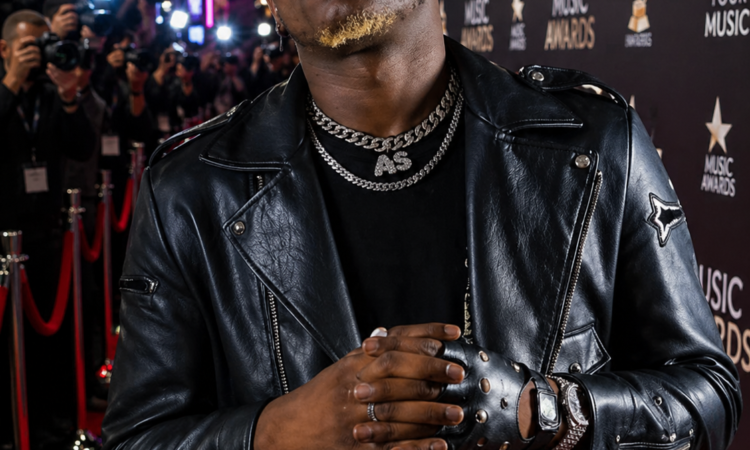
From the Church Pew to the Palais de la Culture
Before the sold-out concerts, the millions of YouTube views, and the nickname that would follow him everywhere — Colonel Lobôffouet — there was a boy sitting in a church pew in Abidjan, absorbing music the way others absorb sunlight. His father stood at the front of the congregation, leading the choir, and young Ariel Jean Arthur Sré watched, listened, and quietly began to understand that sound was not merely something you heard. It was something you could build.
Ariel Sheney — born on July 1, 1990, in the Cocody district of Abidjan, Côte d’Ivoire — did not stumble into music. He was placed inside it from birth. The son of a pastor and choirmaster, he grew up in a household where melody was a form of prayer and rhythm was its own kind of scripture. By the time most children his age were still figuring out the world, Ariel was already navigating it through instrumentation, teaching himself piano, drums, percussion, and guitar with the quiet intensity of someone who already knows their purpose.
He is Guéré by origin, from the western Côte d’Ivoire — a region of resilient people, deep traditions, and a history that has weathered political storms. That identity, rooted in a culture that has known both suffering and celebration, would later infuse every beat he produced, every performance he gave.
The Making of an Arranger
Growing up in Abidjan, Ariel moved through the city’s musical bloodstream. He attended school, took formal music theory and keyboard lessons, and trained informally in production and digital sound mixing — skills that would prove transformative later. But it was not classroom learning that truly shaped him. It was the streets and studios of one of West Africa’s most creatively fertile cities.
His first significant break came in 2010, when he joined the orchestra of RTI — Radiodiffusion Télévision Ivoirienne — as a pianist on the popular Podium program. It was a prestigious placement for a young man not yet twenty-one, a signal that his talent was not merely promising but genuinely exceptional. And it was there, on the set of that television program, that a chance encounter changed the course of his life entirely.
DJ Arafat walked into that studio.
At the time, Arafat was already the undisputed king of coupé-décalé — the high-energy Ivorian genre born in the Parisian diaspora and returned home to conquer the continent. He was charismatic, commanding, and surrounded by his Yorogang, the musical collective that bore his name and his vision. When Arafat noticed the young pianist, he did not simply compliment him. He invited him to perform at his first concert at the prestigious Palais de la Culture.
For Ariel, it was a door swinging open.
Exile, Exile, and the Forge of Talent
In 2011, the post-electoral crisis that gripped Côte d’Ivoire following the disputed presidential election sent tremors through every aspect of Ivorian life. Ariel, like many artists, found himself displaced — ending up in Togo, where, rather than letting uncertainty swallow him, he used the time to sharpen every edge of his craft. He collaborated widely, worked as a music arranger, and built a reputation across borders for a precision and versatility that belied his age.
It was during a concert in Togo that fate looped back around. DJ Arafat, recognizing the young man he had met and then lost track of, extended an invitation to come home — not just to Abidjan, but into the inner circle of the Yorogang itself.
Ariel accepted. He returned to Côte d’Ivoire and embedded himself as arranger and composer within Arafat’s collective, working in the background, shaping the sound that millions would come to love without always knowing his name was behind it. Those years were his true conservatory — not of theory, but of discipline, performance, and the unforgiving demands of professional music-making at the highest level.
The Solo Ascent
By 2015, Ariel Sheney was ready to step into his own light. He launched his solo career with his debut album Dis Moi Master, an introduction to a fully formed artistic identity. Tracks like Kadigbeu and Laisse-moi le Kplo announced a voice that was melodious and distinct — unmistakably rooted in coupé-décalé but reaching outward toward R&B and Afropop with a fluency that felt effortless.
Then came Ghetto.
The track blazed across radio charts and streaming platforms, climbing to the top of the hit parades on Trace Africa for weeks on end. It was the kind of song that lodges itself in the memory of a generation — an anthem that moved between the energy of the dancefloor and the ache of real life. People heard something genuine in it, and they responded. Within the Yorogang, within coupé-décalé, within Abidjan and far beyond, the name Ariel Sheney meant something now. Not just as a craftsman behind the boards, but as an artist in his own right.
In 2017, Ariel won the New Generation Artist award at the Coupé-Décalé Awards — a public acknowledgment of what had been quietly obvious to anyone paying attention. It was also, paradoxically, the moment that ended his relationship with his mentor.
The Break, and the Freedom That Followed
Artistic relationships of great intensity rarely end quietly. Ariel and DJ Arafat’s falling-out in late 2017 was swift and public. Contractual dissatisfactions had been building for some time, and when the moment of rupture came — catalysed in part by the fallout from a concert at the Bataclan in Paris — the split was total. The two men, who had been bound together by music, mentorship, and years of shared work, became rivals.
They did not merely disagree. They sparred through their music, lashing out at each other in tracks that their respective fans consumed with the fascination of spectators at a championship bout. It was messy, as all genuine human conflicts are. But for Ariel, it was also, ultimately, liberating.
Free of the Yorogang, he built something entirely his own.
His single Amina arrived like a declaration. By 2019, the song had surpassed 30 million views on YouTube — a remarkable number that announced his continental arrival not just in Côte d’Ivoire, but across Cameroon, Congo, and beyond. The track blended the infectious propulsion of coupé-décalé with a warmth and pop sensibility that crossed linguistic and cultural borders with ease. Collaborations followed with artists of the stature of Stanley Enow and Diamond Platnumz — names that signalled a career operating at a pan-African scale.
When DJ Arafat died tragically in August 2019 following a motorcycle accident, Ariel was among those who stepped forward to honour his memory, performing at the memorial concert. Whatever the fractures between them, the respect for the man who had first called him onto a stage at the Palais de la Culture had never truly disappeared. In the end, Ariel Sheney paid tribute not because it was expected, but because it was true.
The Colonel and His Country
Ariel Sheney performs under a nickname that tells you something essential about how he moves through the world: Colonel Lobôffouet. Part military allusion, part performative swagger, the name speaks to an artist who commands a stage like a general commands a field — with authority, with precision, and with a sense of spectacle that leaves audiences breathless. He has been photographed arriving at performances in military-inspired dress, with six acrobatic dancers and a full orchestra behind him, reimagining his catalogue live in ways that elevate the songs into something theatrical and immersive.
But beneath the colonel’s uniform beats the heart of someone who has never forgotten where he came from.
In November 2019, he staged his live concert Anitché at the Palais de la Culture in Treichville — a homecoming of sorts, a declaration that his feet were still planted in the city that made him. And in 2021, he launched the inaugural edition of his Aosseh Festival, an event conceived as a celebration of and return to the Guémon region of western Côte d’Ivoire — his ancestral homeland, a place that had suffered profoundly during the crisis years and that Ariel believed deserved its moment in the sun. The festival was not simply entertainment. It was an act of cultural repatriation, an artist using his platform to restore dignity and visibility to a region the world had too often overlooked.
That same year, he stepped fully back into the studio. The single Toffole, released in 2022, found him collaborating with the legendary Koffi Olomidé — whose unmistakable voice graced the track — and confirmed that Ariel Sheney remained not merely current but vital.
The Man Behind the Music
Ariel Sheney is a father. His daughter, Ariella, arrived as both a joy and an anchor — a living reminder that fame is scaffolding around something more permanent. He has spoken openly in interviews about the grounding effect of family, how the presence of a child recalibrates the priorities that celebrity can distort.
His personal life has not been without its sorrows. His wife, Nadiya Sabeh, to whom he was married in a customary ceremony in March 2019, was diagnosed with breast cancer in 2024 — a blow that no public success can buffer against. In the face of this, Ariel has continued to work, to create, and to show up, because that is what artists do when life does not make it easy: they make music anyway.
A Voice That Belongs to the Continent
There is a particular kind of artist who emerges from the specific gravity of a place and time and manages, somehow, to transcend it — to carry their roots into spaces those roots were never supposed to reach. Ariel Sheney is that kind of artist.
He began in a church in Abidjan, learned his craft in an orchestra, was shaped by a mentor, was defined by a rupture, and was confirmed by a song that thirty million people chose to hear. He has given festivals back to forgotten regions, staged concerts of orchestral scale, and collaborated across the continent with a restlessness that suggests a man who has not yet found the ceiling of his ambition.
Coupé-décalé, the genre he calls home, was born in exile and came back to conquer. There is something in that trajectory that mirrors Ariel’s own — the years in Togo, the return, the long climb, the arrival. He has said that he wants to make his mark, that he sees himself as an artist without limits. And looking at the arc of a career that has taken him from a television orchestra to the stages of Paris, from the intimacy of church music to the scale of a continental festival, there is little reason to doubt him.
The colonel is still in the field. And the music is still being made.
Ariel Sheney continues to perform, produce, and build — one of the most distinctive voices in contemporary African music, and a man whose story is still very much in the writing.